

Home/Race Notes/Chip timing
How chip timing actually works.
No battery, no button, nothing to hand back at the finish. Here is what is happening under your bib.
Turn your race bib over. That flat grey rectangle laminated to the back is the entire timing system as far as you are concerned. It weighs almost nothing, it costs us about a dollar, and you throw it away with the bib when you get home. Twenty years ago it was a plastic puck you laced onto your shoe and were fined for losing.

The tag has no power
That rectangle is a passive UHF RFID tag: a tiny chip holding one unique serial number, attached to an antenna printed in aluminium foil. There is no battery in it. There is nothing to switch on, and no way for it to run out mid-race.
When you run over a timing mat, the mat is broadcasting a radio field. Your tag's antenna harvests a small amount of energy out of that field, which is just enough to wake the chip up and make it shout its serial number back. The mat hears it, writes down the number and the exact moment it heard it, and the tag goes dormant again the instant you are past. The whole transaction takes a few milliseconds and happens dozens of times as you cross.
Your bib does not know your name. It knows a number, and a database knows the rest.
That serial number was paired to your registration when the bibs were assigned. This is why wearing somebody else's bib scrambles a race: the chip follows the number, not the runner. Their name gets your time, their age group gets scored with your result, and if they were also running, one of you disappears from the results entirely.
Two mats, one subtraction
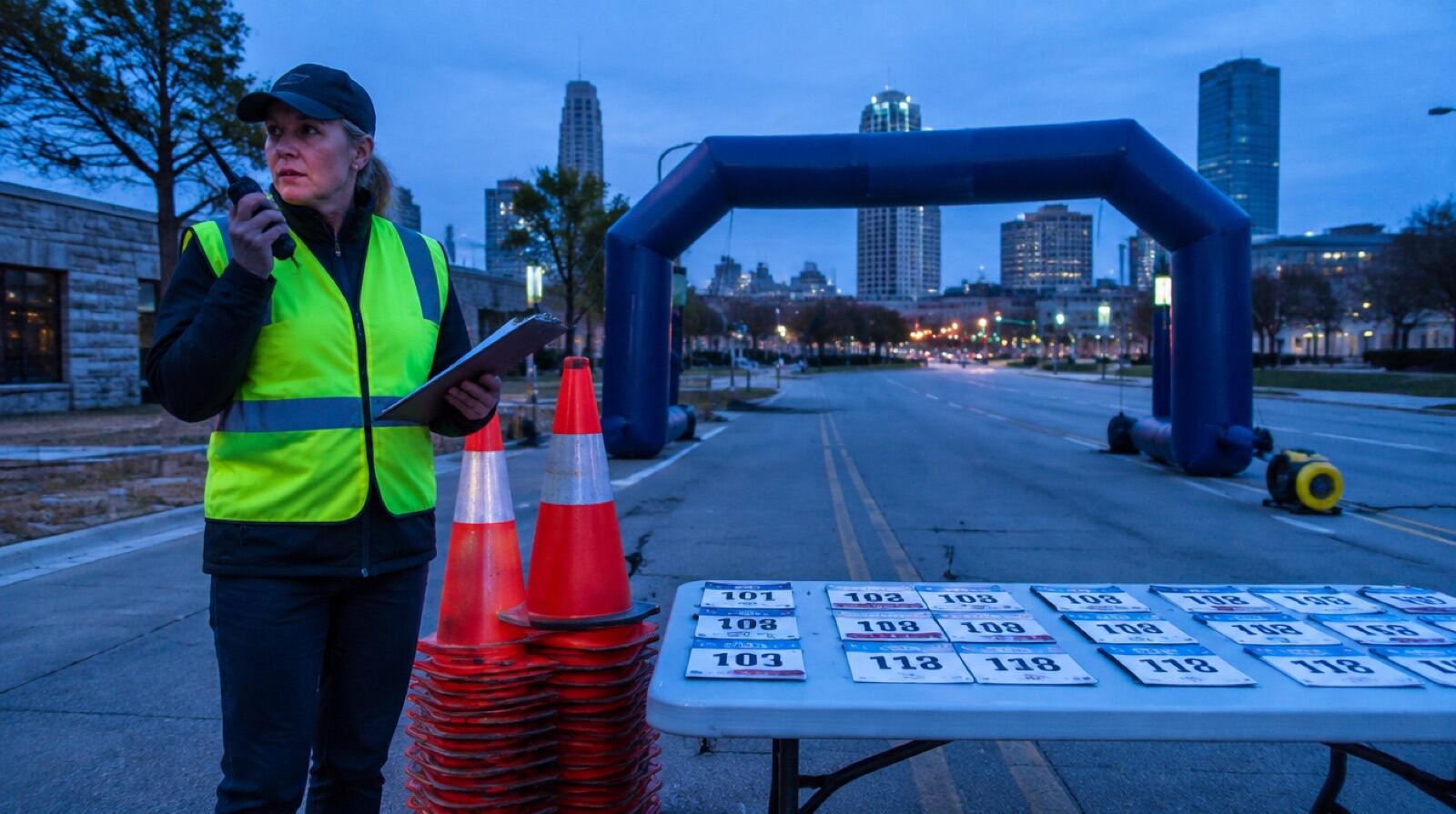
A 5K needs two mats. One at the start line and one at the finish. Longer or more complex courses add split mats, usually at a turnaround or a point where somebody could plausibly cut the course.
Your chip time is simply the finish reading minus the start reading. That is the entire calculation. Everything else in a results file, pace, age group place, overall place, is arithmetic done on top of that one number.


Chip time versus gun time
Gun time starts for every single runner at the horn. Chip time starts when you personally cross the start mat. At a 400-runner 5K the gap between those two things for somebody in the middle of the field is routinely forty to ninety seconds.
Chip time is the honest measure of how fast you ran, and it is the number you should care about. Age group awards are scored on chip time, which is why lining up further back never costs you a medal.
Overall awards are scored on gun time, and that is not us being difficult. The overall winner of a race should be the person who actually crossed the finish line first, not the person whose stopwatch math worked out best. If you are genuinely racing for the win, line up at the front. Everyone else can ignore gun time completely.

What happens when a mat misses
It does happen. Not often, but a 5K where nobody ever gets a bad read does not exist, so every part of our setup assumes it will.
- A backup reader helps. Many timing crews run a second reader on separate power, writing a separate file. If one drops a read, the other usually has it.
- Some races add a finish line camera. Timestamped against the same clock, it lets a missed tag be checked against video and the bib number on the runner's chest.
- Bib folding is the real culprit. A bib folded in half, pinned through the tag, or worn under a zipped jacket blocks the antenna. That is not a system failure, it is a physics problem, and it is why we say four pins and keep it flat.
- A missing start read defaults to gun time. If we have your finish but not your start, you are scored from the horn. You still get a result. It is just slightly slower than the one you earned.
Why results are live now
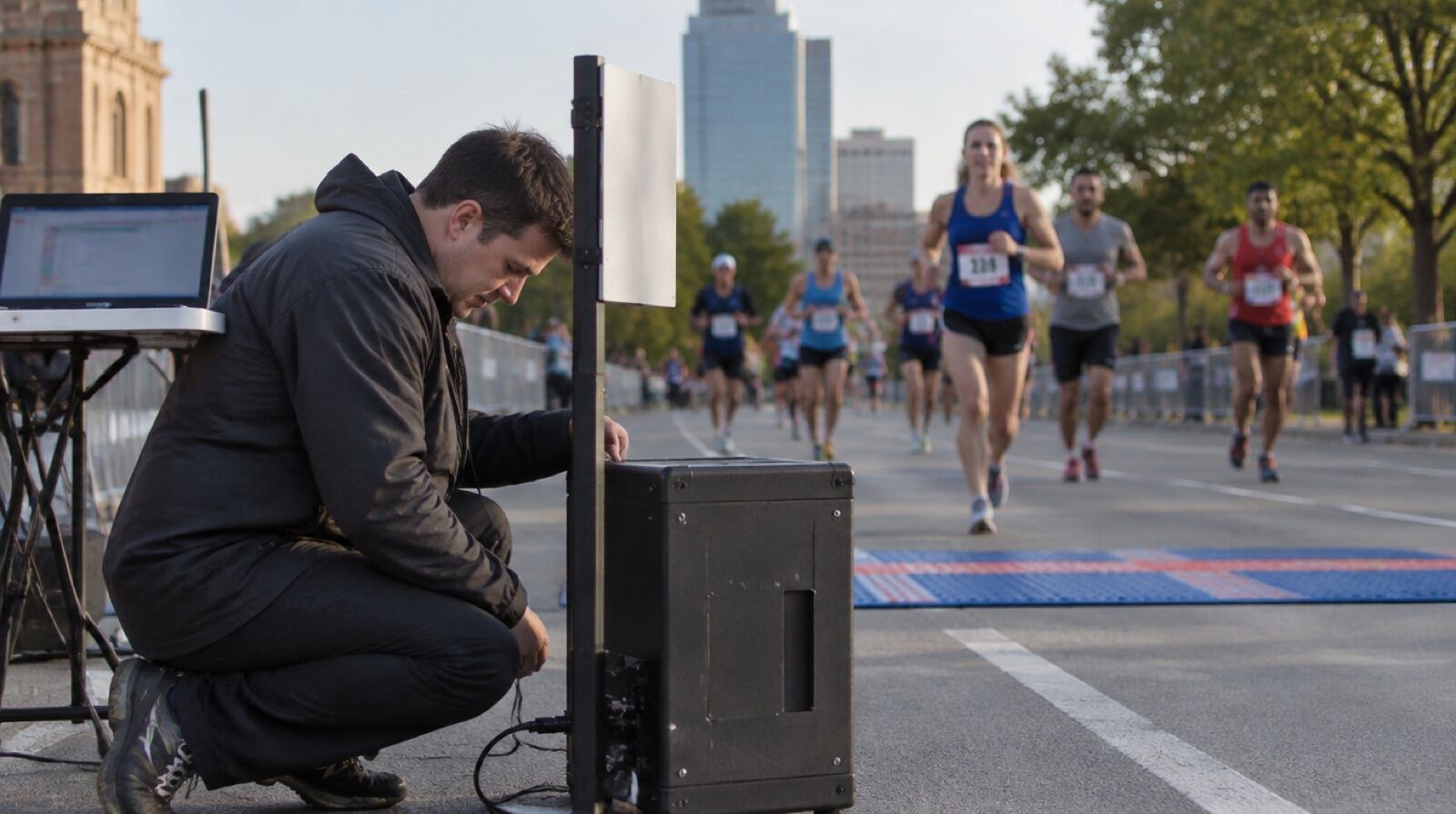
The mats are connected to a laptop at the finish running scoring software, and that software is publishing as it goes. It is not waiting for the race to end. Every read lands in the file within a second or two, the kiosk board at the finish festival refreshes, the public results page updates, and the finisher text goes out.
The practical effect is that age group and overall awards are calculated before the last runner is in, which means awards start on time instead of forty minutes late while somebody types names into a spreadsheet. If you have ever stood around in a car park at 10:30 waiting for a small race to announce its winners, that is the problem this solves.

Results in seconds, not days. It is not a clever trick. It is just the right equipment, run by people who have been the runner standing in that car park.
RUNROO Racing Services times about five chip-timed 5Ks a year in Fort Worth, Texas, and takes timing-only engagements for events we do not otherwise manage. Read the runner guide timing section for the short version.